

Why do many startups fail?
It’s a question founders hear and ask all the time.
Common answers point to funding constraints, execution challenges, team issues, or competition. But when you look across hundreds of failed startups, a more fundamental pattern emerges.
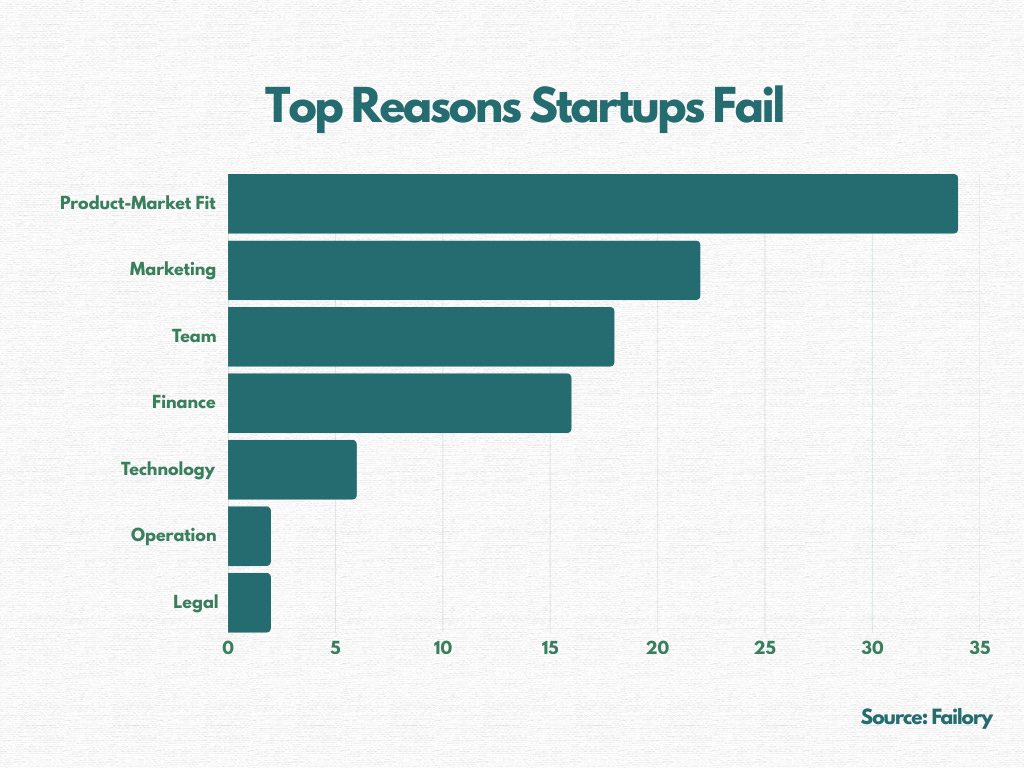
Data compiled by Failory and CB Insights show more than a third of startups fail because they build products without a real market need, in other words, they never achieve product–market fit.
This underscores how costly it can be to build without validated insights.
Customer discovery is how you avoid spending months building the wrong thing.
What is Customer Discovery?
Customer discovery is a disciplined process for understanding:
• who your customer really is
• what painful, urgent problem they face
• how they solve it today and where the gaps are
It is not a survey.
It is not asking, “Would you use my product?”
It is the process of uncovering what is true, not what you hope is true.
Customer Discovery as a Scientific Method
Customer discovery works the same way the scientific method does.
You begin with assumptions:
• who you think the customer is
• what problem you believe they experience
• why the problem matters
• what you think they value
• how you think they behave
These become hypotheses you can validate or invalidate through real conversations.
A hypothesis is not a yes or no question.
It is a testable statement about user behavior, pain, or decision making.
If you invalidate a hypothesis, that is progress.
You are narrowing the search before investing resources.
The PIN + MAP Framework
A simple structure for defining and testing your assumptions.
PIN: Pain, Instance, Negative Outcome
Use PIN to write your problem hypothesis.
Pain: the specific frustration or problem
Instance: when or where it happens
Negative outcome: what consequence it leads to
PIN Formula
“We believe that [target user] experiences [Pain] during [Instance], which leads to [Negative outcome].”
MAP: Method, Advantage, Problem
Use MAP to write a clear solution hypothesis that connects your proposed solution to the problem you believe your target user experiences.
Method: what solution you propose
Advantage: the benefit or improvement it provides
Problem: the problem your solution is designed to address
MAP Formula
“Our solution is [Method] that provides [Advantage] in order to address [Problem] experienced by [target user].”
What Customer Discovery Helps You Avoid
Customer discovery helps reduce this risk in several ways:
Prevents wasted effort
Ten conversations today can save ten months of building something no one needs.Turns assumptions into evidence
Discovery changes guesses into facts you can act on.Builds user empathy
You cannot design for people you do not understand.Creates early champions
Interviewees often become your first pilot users or advisors.Reduces investor risk
Investors want patterns, behaviors, and willingness to pay, not founder intuition.Reveals signals
Recurring frustrations or workarounds point to real opportunities.
What are Signals of a Strong Problem?
Look for these when assessing whether a problem is worth solving:
• High Pain: meaningful frustration or financial loss
• Urgency: the problem needs solving now
• Frequency: it happens repeatedly
• Willingness to Pay: people invest time or money trying to fix it today
You should always gauge whether it is a “Shark Bite” or a “Mosquito Bite.”
Climate Tech Examples Using PIN and MAP Hypothesis Frameworks
Below are four examples of how PIN and MAP frameworks clarify real problems in climate context.
🌾 Off Grid Cold Storage for Farmers
We believe that farmers experience produce spoilage (Pain) during harvest collection when cooling is unavailable near the field (Instance), which reduces income through forced quick sales (Negative outcome).
Our solution is a solar powered cold room (Method) that provides reliable, nearby cooling to reduce spoilage and extend shelf life (Advantage) in order to address the spoilage and income loss farmers experience during harvest (Problem).
💧 Solar Powered Water Pumps
We believe that farmers face high irrigation costs and unreliable water access (Pain) during dry seasons when diesel prices rise or manual pumping fails (Instance), which leads to lower yields and higher operating costs (Negative outcome).
Our solution is a solar powered water pumping system (Method) that provides a predictable and affordable irrigation option (Advantage) in order to address the irrigation challenges farmers experience during dry seasons (Problem).
🔥 Efficient Clean Cookstoves
We believe that households experience high charcoal expenses and smoke exposure (Pain) during daily cooking with inefficient stoves (Instance), which creates financial strain and health risks (Negative outcome).
Our solution is an efficient clean cookstove (Method) that provides reduced fuel use and cleaner combustion (Advantage) in order to address the cooking related expense and smoke exposure challenges households experience (Problem).
🛵 Electric Motorbikes for Delivery Riders
We believe that riders face unstable daily earnings (Pain) during long workdays when fuel prices fluctuate and refueling takes time (Instance), which reduces predictable income (Negative outcome).
Our solution is an electric motorbike supported by battery swapping (Method) that provides lower operating costs and reduced downtime (Advantage) in order to address the income instability riders experience due to fluctuating fuel expenses and refueling delays (Problem).
The Takeaway
Customer discovery is a method, not a checkbox.
It helps founders, especially in climate and deep tech, avoid building in isolation and ensures you are:
• solving the right problem
• for the right user
• at the right time
• with evidence rather than assumptions
Customer discovery is one of the strongest predictors of whether a climate startup will reach its first customer, first pilot, or first investor conversation with confidence.
It is also an ongoing practice, not a step you complete once. As your product, market, and users evolve, discovery continues to guide what you build next.
Every conversation brings clarity. Every insight reduces risk. Keep learning from the people you hope to serve.